Sunday, 6 May 2018

3. Fundamental Rights of Indian Citizens

Fundamental Rights of Indian Citizens


Fundamental Rights of Indian Citizens are provided by the Constitution of India, that was adopted on the 26th of November, in the year 1949, but was put in use on the 26th of January, 1950. The Fundamental Rights of Indian Citizens guaranty that the residents of the land can lead a peaceful life, as long as they inhabit the country. The individual Fundamental Rights of Indian Citizens are most of the time similar in all the democratic countries.

The Individual Fundamental Rights to Indian Citizens include the following:
  • Equality before the law
  • Freedom of religion
  • Freedom of association and peaceful assembly
  • Freedom of speech and expression
  • Right to constitutional remedies for the protection of civil rights
According to the Indian Constitution, there are six basic Fundamental Rights of Indian Citizens, which are right to equality, right to freedom of religion, cultural and educational rights, right to freedom, right to constitutional remedies and right against exploitation.

Article 12 to 35 of the Indian Constitution covers the Fundamental Rights of the citizen of the country. All these Fundamental Rights indicate that all the citizens are equally treated by the nation irrespective of caste, sex and creed. The basic Fundamental Rights enumerated in Part III of the Indian Constitution are categorized under 7 sections apart from the general segment. The sections are as follows:

General Rights:
  • Article 12: The Definition of Fundamental Rights is given in this Article
  • Article 13: The Article comprises Laws of inconsistent with or in derogation of the Fundamental Rights

Right to Equality:
  • Article 14: The provisions regarding Equality before Law are included in this Article
  • Article 15: Prohibition of discrimination on grounds of religion, race, caste, sex or place of birth is specified in this Article
  • Article 16: This Article consists of Rights of Equality of opportunity in matters of public employment
  • Article 17: Abolition of untouchability is mentioned in this particular Article
  • Article 18: This Article provides details about Abolition of titles
Right to Freedom:
  • Article 19: Protection of certain rights regarding freedom of speech, etc. are clearly specified in the Article
  • Article 20: This Article states the Protection in respect of conviction for offenses
  • Article 21: Protection of life and personal liberty is mentioned in the Article
  • Article 22: This Article deals with Protection against arrest and detention in certain cases

Right against Exploitation:
  • Article 23:The details of Prohibition of traffic in human beings and forced labor are presented in this Article
  • Article 24:The Article contains Prohibition of employment of children in factories, etc.


Right to Freedom of Religion:
  • Article 25:Particulars of freedom of conscience and free profession, practice and propagation of religion are clearly enumerated in this Article
  • Article 26:The Article specifies the freedom to manage religious affairs
  • Article 27:Freedom as to payment of taxes for promotion of any particular religion is stated in the Article
  • Article 28:This Article includes freedom as to attendance at religious instruction or religious worship in certain education institutions
Cultural and Educational rights:
  • Article 29:Protection of interests of minorities is specified in detailed form in this Article
  • Article 30:Right of minorities to establish and administer educational institutions is scripted in this very Article
  • Article 31:The Article dealing with Compulsory acquisition of property has been repealed through the Constitution Act, 1978 under 44th Amendment
Saving of Certain Laws:
  • Article 31A:This Article contains savings of laws providing for acquisition of estates, etc.
  • Article 31B:Validation of certain Acts and Regulations are mentioned in the Article
  • Article 31C:This Article deals with saving of laws giving effect to certain directive principles
  • Article 31D:This Article deals with saving of laws giving effect to certain directive principles
Right to Constitutional Remedies:
  • Article 32:Remedies for enforcement of rights conferred by this part have been included in the Article
  • Article 33:This particular Article addresses the Power of Parliament to modify the rights conferred by this Part in their application to forces, etc.
  • Article 34:Restriction on rights conferred by this Part while martial law is in force in any area is mentioned in the Article
  • Article 35:This Article indicates the Legislation to give effect to the provisions of this Part

4. List of Fundamental Duties in Indian Constitution


List of Fundamental Duties in Indian Constitution


Introduction: Originally, the constitution of India did not contain any list of fundamental duties. In other words, enjoyment of fundamental rights was not conditional on the performance of fundamental duties.
Democratic rights are based on the theory that rights are not created by the state. Individuals are born with right. It is on this theory that the Indians before independence raised the slogan that “freedom is our birth right.” It is in this sense again that Professor Laski asserts that the “state does not create rights, it only recognizes rights.”
The socialists on the other hand, make enjoyment or rights conditional on the fulfillment of duties. They claim that “he who does not work, neither shall he eat.” The constitution of the world’s first socialist country, that of Soviet Union contains a list of fundamental rights immediately followed by a list of fundamental duties. It is clearly asserted that the enjoyment of fundamental rights is conditional on the satisfactory performance of fundamental duties.
It was on this Soviet model that fundamental duties were added to the Indian Constitution by 42nd amendment of the constitution in 1976. The fundamental duties are contained in Art. 51A.
List of Fundamental Duties: Art. 51A, Part IVA of the Indian Constitution, specifies the list of fundamental duties of the citizens. It says “it shall be the duty of every citizen of India:
  1. to abide by the constitution and respect its ideal and institutions;
  2. to cherish and follow the noble ideals which inspired our national struggle for freedom;
  3. to uphold and protect the sovereignty, unity and integrity of India;
  4. to defend the country and render national service when called upon to do so;
  5. to promote harmony and the spirit of common brotherhood amongst all the people of India transcending religious, linguistic and regional diversities, to renounce practices derogatory to the dignity of women;
  6. to value and preserve the rich heritage of our composite culture;
  7. to protect and improve the natural environment including forests, lakes, rivers, and wild-life and to have compassion for living creatures;
  8. to develop the scientific temper, humanism and the spirit of inquiry and reform;
  9. to safeguard public property and to abjure violence;
  10. to strive towards excellence in all spheres of individual and collective activity, so that the nation constantly rises to higher levels of endeavor and achievement. Further, one more Fundamental duty has been added to the Indian Constitution by 86th Amendment of the constitution in 2002.
  11. who is a parent or guardian , to provide opportunities for education to his child, or as the case may be, ward between the age of six and fourteen years.
Why fundamental duties are important? We should all acknowledge our responsibility to perform our fundamental duties. The importance of fundamental duties are highlighted below:
  • The fundamental duties enumerated in Article 51A constitute a constant reminder to the citizens that they have duties in building up a free, egalitarian, healthy and responsible society. These are expected to act as damper to reckless and anti-social activities on the part of some individuals.
  • India is a multi-racial and multi-religional country. Such a vast democratic country like India can prosper only when the citizens of this country respect its integrity and promotes cultural harmony.
  • It is important to respect womanhood and citizens of India are expected to refrain from practices that are dis-respectful towards women.
  • Environmental pollution has become a great cause of concern, not only for Indian, but for the entire humanity. Unless, we all take the pledge to keep our environment free from pollutants, there remains the threat of undesirable consequences.
  • The fundamental duties aims at safeguarding public properties.
  • The inclusion of providing opportunity for education for children as a Fundamental duty is a big step forward towards safeguard of human-rights and abolition of social injustices
Non-enforceable and Non-justiciable: The fundamental duties however are non-enforceable and non-justiciable in character. This means that no citizen can be punished by a court for violation of a fundamental duty. In this respect the fundamental duties are like the directive principles of the constitution in part IV. The directive principles lay down some high ideals to be followed by the state. Similarly, the fundamental duties in Art 51A, lay down some high ideals to be followed by the citizens. In both cases, violation does not invite any punishment. It is significant that the fundamental duties are placed at the end of part IV rather than at the end of part III of the constitution. While part III containing fundamental rights is justiciable, part IV containing the directive principles is not.
Conclusion: These fundamental duties are not mere expressions of pious platitudes. Courts will certainly take cognizance of laws seeking to give effect to fundamental duties.
Finally, the very fact that these duties figure in the constitution, keeps the door open for the duties to be given higher constitutional at status in future through constitutional amendments.

5. Directive Principles of Our State Policy : Part IV (Articles 36-51)


Directive Principles of Our State Policy : Part IV (Articles 36-51)


The concept of Directive Principles of State Policy was borrowed from the Irish Constitution. While most of the Fundamental Rights are negative obligations on the state, DPSPs are positive obligations on the state, though not enforceable in a court of law.

Article 36: Definition

In this Part, unless the context otherwise requires, “the State” has the same meaning as in Part III.

Article 37: Application of the principles contained in this Part

The provisions contained in this Part shall not be enforced by any court, but the principles therein laid down are nevertheless fundamental in the governance of the country and it shall be the duty of the State to apply these principles in making laws.

Article 38: State to secure a social order for the promotion of the welfare of the people

(1) The State shall strive to promote the welfare of the people by securing and protecting as effectively as it may a social order in which justice, social, economic and political, shall inform all the institutions of the national life.
(2) The State shall, in particular, strive to minimise the inequalities in income, and endeavour to eliminate inequalities in status, facilities and opportunities, not only amongst individuals but also amongst groups of people residing in different areas or engaged in different vocations.

Article 39: Certain principles of policy to be followed by the State

The State shall, in particular, direct its policy towards securing –
(a) that the citizen, men and women equally, have the right to an adequate means of livelihood;
(b) that the ownership and control of the material resources of the community are so distributed as best to subserve the common good;
(c) that the operation of the economic system does not result in the concentration of wealth and means of production to the common detriment; 
(d) that there is equal pay for equal work for both men and women;
(e) that the health and strength of workers, men and women, and the tender age of children are not abused and that citizens are not forced by economic necessity to enter avocations unsuited to their age or strength;
(f) that children are given opportunities and facilities to develop in a healthy manner and in conditions of freedom and dignity and that childhood and youth are protected against exploitation and against moral and material abandonment.

Article 39A: Equal justice and free legal aid

The State shall secure that the operation of the legal system promotes justice, on a basis of equal opportunity, and shall, in particular, provide free legal aid, by suitable legislation or schemes or in any other way, to ensure that opportunities for securing justice are not denied to any citizen by reason of economic or other disabilities.

Article 40: Organisation of village panchayats

The State shall take steps to organise village panchayats and endow them with such powers and authority as may be necessary to enable them to function as units of self-government.

Article 41: Right to work, to education and to public assistance in certain cases

The State shall, within the limits of its economic capacity and development, make effective provision for securing the right to work, to education and to public assistance in cases of unemployment, old age, sickness and disablement, and in other cases of undeserved want.

Article 42: Provision for just and humane conditions of work and maternity relief

The State shall make provision for securing just and humane conditions of work and for maternity relief.

Article 43: Living wage, etc., for workers

The State shall endeavor to secure, by suitable legislation or economic organisation or in any other way, to all workers agricultural, industrial or otherwise, work, a living wage, conditions of work ensuring a decent standard of life and full enjoyment of leisure and social and cultural opportunities and, in particular, the State shall endeavour to promote cottage industries on an individual or co-operative basis in rural areas.

Article 43A: Participation of workers in management of industries

The State shall take steps, by suitable legislation or in any other way, to secure the participation of workers in the management of undertakings, establishments or other organisation engaged in any industry.

Article 44: Uniform civil code for the citizen

The State shall endeavour to secure for the citizens a uniform civil code throughout the territory of India.

Article 45: Provision for free and compulsory education for children

The State shall endeavour to provide, within a period of ten years from the commencement of this Constitution, for free and compulsory education for all children until they complete the age of fourteen years.

Article 46: Promotion of educational and economic interests of Scheduled Castes, Scheduled Tribes and other weaker sections

The State shall promote with special care the educational and economic interests of the weaker sections of the people, and in particular, of the Scheduled Castes and the Scheduled Tribes, and shall protect them from social injustice and all forms of exploitation.

Article 47: Duty of the State to raise the level of nutrition and the standard of living and to improve public health

The State shall regard the raising of the level of nutrition and the standard of living of its people and the improvement of public health as among its primary duties and, in particular, the State shall endeavour to bring about prohibition of the consumption except for medicinal purpose of intoxicating drinks and of drugs which are injurious to health.

Article 48: Organization of agriculture and animal husbandry

The State shall endeavour to organize agriculture and animal husbandry on modern and scientific lines and shall, in particular, take steps for preserving and improving the breeds, and prohibiting the slaughter, of cows and calves and other milch and draught cattle.

Article 48A: Protection and improvement of environment and safeguarding of forests and wildlife

The State shall endeavour to protect and improve the environment and to safeguard the forests and wildlife of the country.

Article 49: Protection of monuments and places and objects of national importance

It shall be the obligation of the State to protect every monument or place or object of artistic or historic interest, declared by or under law made by Parliament to be of national importance, from spoliation, disfigurement, destruction, removal, disposal or export, as the case may be.

Article 50: Separation of judiciary from the executive

The State shall take steps to separate the judiciary from the executive in the public services of the State.
Article 51: Promotion of international peace and security
The State shall endeavour to –
(a) promote international peace and security;
(b) maintain just and honourable relations between nations;
(c) foster respect for international law and treaty obligations in the dealings of organised people with one another; and
(d) encourage settlement of international disputes by arbitration.

6. Indian Parliament

Indian Parliament

The Union Parliament consists of the President and two Houses Lok Sabha and Rajya Sabha.

Rajya Sabha

Composition: It consists of not more than 250 members, out of which 238 are elected and the remaining 12 nominated by the President for their special contribution to art, literature, science and social services. The elected members are chosen by the State Assemblies in accordance with the system of proportional representation by means of a single transferable vote. The allocation of seats among the States is not on the basis of equality of representation. In the case of Union Territories members are chosen in such a manner as the Parliament by law determines. A candidate for election to the Council of States (Rajya Sabha) must be
  1. a citizen of India:
  2. not less than 30 years of age
  3. not holding any office of profit under the Government: And
  4. ordinarily a resident of the State from which he is contesting. Duration: The Council of States is a permanent body, not subject to dissolution. The term of office for its members is six years, one third of the members retiring after every second year. Other Provisions: The Vice President of India is ex-officio Chairman of the Council of States. The Council elects one of its members as Deputy Chairman. Who presides over its meetings in the absence of the Vice President. But whenever the Council is considering a Resolution for the removal of the Vice President or the Deputy Chairman from his office. These officers shall not preside over the sitting of the House, nor can they carry on the resolution, though they are entitled to speak. Powers and Functions: With regard to legislative powers, the authority of the Rajya Sabha is co-extensive with that of the Lok Sabha. No measure can become a law. Unless it has been passed by the Rajya Sabha. It exercises control over the Union Administration by seeking information. By means of questions and supplementaries by moving resolutions or motions of adjournment or censure. But it cannot oust the Ministry from office. As regards the Money Bills. These cannot be introduced in the Council of States. Also when a Money Bill is passed by the Lok Sabha and transmitted to the Rajya Sabha, the iatt2r can delay the Bill for 14 days. It cannot reject the Bill

Lok Sabha

Composition: It consists of not more than 552 members, out of which 530 members are elected from States and not more than 20 members from the Union Territories and tribal areas. The representatives from the States 8redirectly elected by the people on the basis of adult franchise. At present there are 543 elected members. The representatives of the Union Territories are to be chosen in such manner as the Parliament may, by law, provide. The President can also nominate two Members to Lok Sabha to represent the Anglo-Indian community if, in his opinion, it is not adequately represented. Art. 331 A member for election to Lok Sabha must be
  1. a citizen of India
  2. not less than 25 years of age
  3. not holding any office of profit. The number of seats to each State is so allotted that the ratio between the members and population, as far as practicable, is the some for each State. Each member of the House should represent not less than lakh citizens. Tenure: Lok Sabha has a tenure of 5 years unless dissolved earlier. But while a Proclamation of Emergency under Art. 352 is in operation, this period may be extended for a period not exceeding one year at a time and not exceeding in any case beyond a period of six months after the proclamation has ceased to operate.

Disqualification of Members of Parliament

A person shall be disqualified for being chosen as, and for being, a member of either House of Parliament:
  • if he holds any such office of profit under the Government of India or Government of State, as is declared by Parliament. By law to disqualify its holder
  • if he is of unsound mind and stands so declared by a competent court
  • if he is an undischarged insolvent
  • if he is not a citizen of India or has voluntarily acquired citizenship of a foreign State
  • if he is so disqualified by any law made by Parliament. Powers and Functions of Parliament

Functions

  1. Its main function is to enact laws for the good government of the country.
  2. It can pass a vote of No-confidence and thus dismiss the Government in power.
  3. It controls the finances of the Union.
  4. The members can elicit information by asking questions and supplimentaries.
  5. The members can move adjournment motions and thus criticize the government.
  6. It can impeach the President in case he violates the Constitution.
  7. Maximum Gap between two sessions of Parliament is 6 months under Art. 85 (1).

7. High Court

High Court

• The judiciary in the states consists of a High Court and a system of subordinate courts below it.
• The High Court is at the apex of the judiciary in the state.
• Article 214 provides for High Court for each state but there can be common High Courts for two or more states established by Parliament under Article 231.
• Under Article 230 the jurisdiction of High Court can be extended to the Union Territories also.
• At present there are only 24 High Courts covering all the 29 states and 7 Union Territories.
• A High Court may also have one or more benches of itself within the area of its territorial jurisdiction.
Indian High court Act, 1861
• High courts established at Calcutta, Bombay & Madras
• Constitution states that there shall be HC in every state, but, parliament has the power to establish a common HC for 2 or more states (At present 24 HC for 29 states & 7 UTs)
• Strength of HC is flexible (Unlike SC – which can be increased by parliament)
• President may from time to time appoint judges of HC, keeping in view amount of work before HC.
Appointment of High Court Judges:
Initiation of proposal for appointment of judges of HC must invariably be made by CJ of that HC
Appointment is made with respect to recommendations of NJAC
Composition of the NJAC – 6 members
• Chief Justice of India (Chairperson, ex officio)
• Two other senior judges of the Supreme Court next to the Chief Justice of India – ex officio
• The Union Minister of Law and Justice, ex-officio
• Two eminent persons (one of which would be from the SC or ST or OBC or Minority communities or a woman ), for 3 yrs, not eligible for re-nomination, to be nominated by a committee consisting of :
– Chief Justice of India
– Prime Minister of India
– Leader of opposition in the Lok Sabha ( where there is no such Leader of Opposition, then, the Leader of single largest Opposition Party in Lok Sabha)
Functions of the Commission:
Recommending persons to president for appointment as:
• Chief Justice of India,
• Judges of the Supreme Court,
• Chief Justices of High Courts and other Judges of High Courts.
– Recommending transfer of Chief Justices and other Judges of High Courts from one High Court to any other High Court
– Ensuring that the persons recommended are of ability and integrity

Tenure of High Court Judges

• 62 Years
• Any dispute regarding the age of judge of HC is decided by President in consultation with CJ of India
Removal of High Court Judges
• HC judge can resign by writing to President; or
• By same removal process as in case of SC judges
Salary of High Court Judges
• CJ – Rs. 90,000
• Others – Rs.80,000
• From consolidated fund of State
Oath – before Governor (Unlike before President as in case of Supreme Court)
Qualification for High Court Judges
• Must be citizen of India
• Must have held a judicial office in territory of India for atleast 10 years or
• Must have been an advocate of HC in succession for 10 years
After retirement a judge of HC cannot plead in a court or before any authority in India except in SC or HC other than in which he held office
Jurisdiction of High Court
A. Original Jurisdiction
• In civil cases with amount > 2000
• In criminal cases, authorised to them by President Magistrates
B. Appellate Jurisdiction
All HCs entertain appeals in civil & criminal cases from their subordinate courts.
They have, however, no jurisdiction over tribunals established by the law relating to armed forces of the country
C. Writ Jurisdiction:
• Jurisdiction to issue writs under HC is larger than the SC.
• SC can issue them only where a FR has been infringed whereas a HC can issue them, not only in such cases but also where an ordinary legal right has been infringed
D. Administrative & supervisory Functions of HC:
• HC supervise & controls the working of courts subordinate to them
• Frame rules & regulations for transactions of their business. For ex. Transfers, Postings, Promotions etc.
• Not applicable in case of tribunals dealing with armed forces
(HC acts as court of records & has power to punish its own contempt)
Superintendence over Courts:
• Under Article 227 every High Court has a power of superintendence over all courts and tribunals throughout the territories in relation to which it exercises jurisdiction. Superintendence covers both administrative as well as judicial.
• The power of superintendence is an extraordinary power to be exercised most sparingly and only in appropriate cases in order to keep the subordinate courts within the bounds of their authority and not for making trifle corrections.
• The High Court should intervene in cases of gross injustice or non-exercise or abuse of jurisdiction even though there is no provision for appeal or revision.
Transfer of Certain Cases to High Court (Article 228):
If the High Court is satisfied that a case pending in a subordinate Court involves a substantial question of law as to the interpretation of the Constitution, the High Court will withdraw the case and either determine the question of law and return the case to the court from where it was withdrawn or dispose of the case itself.
Control over the Subordinate Judiciary:
As the head of the judiciary in the State, the High Court has got an administrative control over the subordinate judiciary in respect of certain matters. The subordinate courts include District Judges of the city, Civil Courts as well as the Metropolitan Magistrates and Members of the Judicial Services. The control over the judges of these subordinate courts is exercised by the High Court in the following matters-
• The High Court is to be consulted by the Governor in the matter of appointing, posting and promoting district judges.
• The High Court is consulted along with the state Public Service Commission, by the Governor, in appointing persons to the judicial service of the state.
• The control over district courts and courts subordinate thereto, including the posting and promotion of and the grant of leave to persons belonging to the judicial service and holding any post inferior to the post of a district judge is vested in the High Court.
The initial appointment of a District Judge or Additional District Judge is made by the Governor who has to act in consultation with the High Court. After he is appointed his posting and promotion is done by the Governor in consultation with the High Court (Article 233). Normally the High Court’s recommendation must be accepted. Departure from it must be rare and for cogent and compelling reasons.
The posting and promotion of the district judge is done by the Governor in consultation with the High Court but posting and promotion of persons belongings to state judicial service (other than district judges) exclusively rests with the High Court (Article 235).
Article 235 expressly states that the control over district court and courts below it vest in the High Court. The control is administrative, removal or reduction in rank. In the matter of dismissal, removal and reduction also the High Court may recommend such punishment to the Governor.
Powers to issue writs:
• The Supreme Courts and High Courts can issue writs to ensure that rights of the people are not violated either by State or otherwise.
• The Constitution has specifically given the power ‘to issue certain writs’ to the High Courts.
• These Courts can issue writs (which are binding directions of the Court) to any person or authority, including government of the State concerned.
• The writs in the nature of Habeas, Corpus, mandamus, prohibition, quo warranto, and certiorari (explained in lesson 6) for the enforcement of rights of the people.
• This power is exercised in the original jurisdiction of the High Court, and is not derogatory to similar power of the Supreme Court.
Transfer of Cases to the High Court
• If a High Court is satisfied that a case pending in a subordinate court involves a substantial question of law as to the interpretation of the Constitution, the High Court may withdraw such a case from the lower court.
• After examining the case, the High Court may either dispose it off itself, or may return it to the lower court with instructions for disposal of the case.
Superintendence of Subordinate Courts
• A High Court has the right of superintendence and control over all the subordinate courts in all the matter of judicial and administrative nature.
• In the exercise of its power of superintendence, the High Court may call for any information from the lower courts; may make and issue general rules and prescribe norms for regulating the practice and proceedings of these courts; and it may issue such directions, from time to time, as it may deem necessary.
• It can also make rules and regulations relating to the appointment, demotion, promotion and leave of absence for the officers of the subordinate courts.
Court of Record
• A High Court is also a court of record, like the Supreme Court.
• Lower courts in a State are bound to follow the decisions of the High Court which are cited as precedents.
• A High Court has also the power to punish for its contempt or disrespect.

7.1 Supreme Court

Supreme Court

• Judiciary is that branch of government which interprets law, settles disputes and administers justice. Laws are like dead letters without courts to explain and expound their meaning.
• Judiciary is the watchdog of democracy, guardian of the constitution as well as champion of liberty.
• In India the structure of judiciary is like a pyramid. The Supreme Court is at the apex, below it, there are High Courts, the next step in the hierarchy are the district courts and at the bottom of the judicial pyramid are the subordinate courts.
• In India, the courts from top to bottom deal with the disputes arising under the laws enacted by the Union Parliament as well as by state legislatures.

THE FUNCTIONS OF THE JUDICIARY

SUPREME COURT
• Independent Judiciary : Sine – Qua – Non of Democracy (Absolutely needed)

• Exist to see that laws made by legislature are intra vires (with the constitution)
• At the apex lie SC : Custodian & interpreter of constitution
• Originally 1 CJ & 7 judges, but At present 1 CJ & 30 Judges
Seat:
SC normally seats at New Delhi. However it can be hold its meeting anywhere in India. The decision I this regard is taken by the CJI in consultation with the President.
Appointment of the Chief Justice of India:
• There is no procedure laid down for the appointment of the Chief Justice of India.
• A convention was followed to appoint the senior most judge as the Chief Justice until it was broken by Mrs. Indira Gandhi who appointed justice A. N. Ray as the chief justice superseding three senior justices of the Supreme Court.
• The Supreme Court has laid down in a judgment that only the senior most judge of the Supreme Court is eligible to become the Chief Justice.
• At present the convention of appointing the senior most judge as the chief justice prevails.
Appointment of Judges (Art. 124)
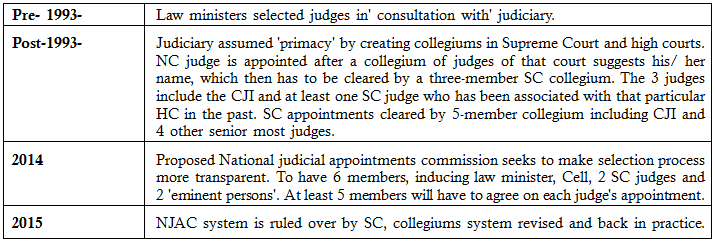
• Every judge of the Supreme Court shall be appointed by the President after consultation with such judges of the Supreme Court and of the High Court as the President may deem necessary.
• In case of the appointment of a judge other than the chief justice, the chief justice of India shall always be consulted.
• The consultation process has been made systematic, elaborate and effective by the Supreme Court in various cases known as Supreme Court Judges case.
• The Supreme Court has held that the Chief Justice must consult the four senior most judges of the Supreme Court and if two judges give an adverse opinion, the Chief Justice should not send the recommendation to the government.
• Thus, the word consultation with the judiciary while appointing the Supreme Court judges has been practically converted into concurrence.
Qualification for appointment as a Judge (Art. 124):
No person shall be qualified for appointment as a judge of the Supreme Court unless he is:-
• a citizen of India; and
• has been for at least 5 year a judge of a High Court; or
• has been for at least 10 years an advocate of High Court; or
• is in the opinion of the President, a distinguished jurisdictions. (a highly qualified academia / law professor)
Tenure:
• A judge of the Supreme Court holds office until he attains the age of 65 years. No minimum age for appointment is fixed. A judge may at any time resign his office by writing addressed to the President.
• 3 years more than that of High court Judge
• He may be removed by the President by an order issued after being presented an address by each House of Parliament passed by special (also known as double majority) majority.
• Such removal can be on the ground of (a) proved misbehaviour or (b) incapacity.
Salary of Supreme Court Judges:
• Chief Justice -1 lakh
• Other Judges -90,000 (From consolidated fund of India)
Appointment of acting Chief Justice (Art. 126)
• In case of absence of the Chief Justice of the Supreme Court by any reason, the President may appoint a judge of the Supreme Court as the acting Chief Justice during such absence.
Ad-hoc Judges (Art. 127)
• The Chief Justice with the previous consent of the President can ask a High Court judge after consulting the chief justice of that High Court to attend at the sittings of the Supreme Court as an ad hoc judge.
• The ad hoc judge will have all the jurisdiction, powers and privileges of a judge of the Supreme Court.
Attendance of retired Judges (Art. 128)
• The chief justice may with the prior consent of the President request a retired judge of the Supreme Court or a High Court who is qualified to be judge of the Supreme Court to and act as a judge of the Supreme Court.
• The President may determine his allowances. He shall have all the jurisdiction, powers and privileges of the Supreme Court. But he shall not be deemed to be a judge of the Supreme Court.
Removal of Supreme Court judges Art. 124(4):
The manner of removal of a Supreme Court judge which is an impeachment like process. A judge may be removed from his office on the ground of (a) misbehavior or (b) incapacity. The removal involves the following steps:
• A motion for presenting an address to the President praying for the removal of a judge must be signed by at least 100 members of the Lok Sabha (if notice is given in the Lok Sabha).
• The Chairman or the Speaker (as the case may be) may consult such persons as he thinks fit and consider such material as may be available and may admit the motion or refuse to admit it.
• If the motion is admitted, a committee consisting of 3 persons will be constituted of whom,
– One shall be from among the Chief Justice and judges of the Supreme Court.
– One shall be from among the Chief Justice and the judges of the High Court.
– One shall be a person who is a distinguished jurist.
• If the committee arrives at a finding that the judge is guilty of misbehaviour or suffers from an incapacity, then the motion for removal of the judge together with the report of the committee will be taken up for consideration in the House in which it is pending.
• The motion must be passed by each House by a majority of the total membership of that House and by a majority of not less than two-third of the members of that House present and voting. After being so passed, the address is presented to the President.
• The President passes an order removing the judge.
• By order of President, after an address in each house of parliament, supported by a majority of total membership of the house & passed by a resolution supported by not less than 2/3rd of the members present & voting.
– Lok Sabha: A motion can be preferred before the house if signed by 100 members
– Rajya Sabha: A motion can be preferred before the house if signed by 50 members
o Only on grounds of proven misbehavior or incapacity
o Only after giving 14 days prior notice to said Judge against whom the motion is passed
o A 3 persons judicial committee is formed headed by serving judge of SC and 2 others from (SC or HC or eminent jurists)
o Report of same must be passed by both the houses & President
Acting CJ & Ad Hoc Judges
• Appointment of Acting CJ – By President if CJ is ill or incapable to serve
• Appointment of Ad-hoc Judges – IF there is lack of quorum of Judges of SC to hold or continue any session in court, CJ of India with previous consent of President & after consultation with CJ of HC concerned, request in writing the attendance of judges to sit in SC as ad-hoc judges for certain period (Judges shall be qualified to be judges of SC)
Retired judges of SC can sit in SC as Ad-hoc Judges on request of CJ after consent of President, provided they fulfill the criteria of SC’
• Criminal proceedings initiation against a judge of SC or HC requires CJs consent
• After retirement, a Judge of SC is prohibited from practising or acting as a judge in any court.
Independence of Supreme Court:
The Constitution secures the independence of the judges of the Supreme Court by the following provisions:
• The appointments are made by the President in consultation with the Chief Justice of India.
• The judges are to be removed by Parliament through a tough impeachment process. They cannot be removed by the executive.
• Salaries, allowances and pensions of Supreme Court judges are charged on the Consolidated Fund of India (CFI) and shall not be varied to their disadvantage.
• The conduct of a judge cannot be discussed in the parliament or any legislature (Art.121 and 211).
• A retired judge of the Supreme Court is prohibited from pleading or acting in any Court or authority in India.
Supreme Court to be a court record:
The Supreme Court is a Court of record (Art. 129). It means that its record has evidentiary value and cannot be questioned when produced in a Court. It also means that it has the power to punish for contempt.
JURISDICTION AND POWER OF SUPREME COURT:
A. Original Jurisdiction
• Original jurisdiction of SC is power to hear a case for the 1st time unlike Appellate jurisdiction
• Purely federal in character i.e. have exclusive authority to decide any dispute involving a question of law between:
– GOI (Union) v/s state or states
– GOI & any state / states on one side & state / states on the other
– Two or more states
However, according to 7th amendment, 1956, original jurisdiction of SC does not extends to disputes, arising out of provisions of a treaty, agreement etc. which was executed before 26th Jan 1950 & is in operation ever since.
As per article 71, all disputes regarding election of President & vice President are handled by SC
Exclusion to original jurisdiction of states (Art.131)
• In disputes between center & state due to disputes arising out of provisions of a treaty, agreement etc. which was executed before 26th Jan 1950 & is in operation ever since
• Parliament may by law exclude SC’s jurisdiction in disputes with respect to use, distribution & control of water in any interstate river
Exclusive jurisdiction in following cases:
• Between the government of India and one or more states.
• Between the government of India and one or more states on one side, and one or more states on the other.
• Between two or more states.
– The dispute must involve any question of law or fact on which the existence or extent of a legal right depends.
– A legal right is one which is capable of enforcement by a Court law. It must be based on a rule of positive law and not be a matter of political considerations.
Writ Jurisdiction (Art.32)
• A type of original jurisdiction of Supreme court
• Jurisdiction of SC to enforce FRs – Every individual has a right to move to SC directly by appropriate proceedings for the enforcement of his FR, without coming via HC, by means of writs.
B. Appellate Jurisdiction:
Constitutional Matters (Art.132):
• Appeal lies to SC if HC certifies that the case involves a substantial question of law as to interpret the constitution
• If HC refuses to give certificate, SC may grant a special leave for appeal if it is satisfied that case does involve such question
Civil Matters:
An appeal lies to SC from any any judgement in civil proceeding of HC if it certifies :
• that the case involves a substantial question of law of general importance
• that in opinion of HC, the said question needs to be decided by SC
Thus, No appeal in case of civil matters lies to SC as a matter of right as it lies only when HC issues a certificate on above 2 conditions
Criminal Matters (Art.134):
Constitution provides the following provisions as to appeal in criminal matters:
• If HC has sentenced someone to death
• If HC has withdrawn for trial before itself a case from the lower court & in such trial, lower court has sentenced the accused to death
• If HC certifies that the case is fit for appeal to SC, even if HC on appeal has reversed an order of acquittal of accused & sentenced him to death or life imprisonment or for period not less than 10 years
(Appellate Jurisdiction is not Applicable in cases of Court Martial)
Grant of special leave to appeal – Article 136
Articles 131, and 133 provide for appeals to the Supreme Court from constitutional, civil and criminal matters respectively.
• Under Article 136, the Supreme Court has the power to grant special leave to appeal from any judgement, decree, determination, sentence or order of a Court or tribunal except military tribunals. In the earlier articles, the appeals flow only from the determinations of a High Court.
• Article 136 puts no such restrictions. Under this article, the Supreme Court may hear an appeal even from a subordinate court or tribunal. Even where the law does not provide for any appeal, e.g., from Industrial Tribunals, Election Tribunals, the Central Board of Revenue, the Central Government, the Railway Rates Tribunal, etc.
Advisory Jurisdiction (Only consultative Role):
• President can refer to court either on a question of law or on a question of fact provided it is of public importance. However, it is not compulsory for court to give its advice.
• Further, President is empowered to refer to SC for its opinion regarding disputes, arising out of provisions of a treaty, agreement etc. which was executed before 26th Jan 1950 & is in operation ever since. In such case, it is obligatory for the court to give its opinion to President
(In this cases, opinion expresses by SC is only advisory in nature & not binding on President)
C. Revisory Jurisdiction:
• Empowered to review any judgment or order made by it with a view to remove any mistake or error that might have crept in judgment
• Even though, judgment have been passed by SC has a binding effect on all the courts of India, but not on SC itself.
D. Supreme Court as Court of Record:
• Records & judicial proceedings are of evidentiary value before any court
• Has power to determine its own jurisdiction
Review of judgements for orders by the Supreme Court (Article 137)
Under this provision the Supreme Court has the power to review its own judgement. Since there is no court above Supreme Court, its judgement can be reviewed by no court but by itself. A review will lie on the following grounds:
– Discovery of new and important matters or evidence;
– Mistake or error apparent on the face of the record; and
– Any other sufficient reason.
Transfer of certain cases (Article 139 A):
In cases involving the same questions of law having general importance, the Supreme Court may withdraw such cases and dispose them itself.
Advisory jurisdiction (Article 143):
• The power of consulting the Supreme Court by the President on a matter affecting the nation is known as advisory jurisdiction of the Supreme Court.
• If the President at any time feels that a question of law or fact of public importance has arisen which requires the opinion of the Supreme Court, he may refer the matter to the Supreme Court to seek its advice.
• However, the President is not bound by the advice given by the Supreme Court nor Supreme Court is bound to tender its advice always.
Transfer of Certain Cases to High Court (Article 228):
If the High Court is satisfied that a case pending in a subordinate Court involves a substantial question of law as to the interpretation of the Constitution, the High Court will withdraw the case and either determine the question of law and return the case to the court from where it was withdrawn or dispose of the case itself.
Contempt of court:
(Supreme Court has power to punish its own contempt)
• Civil – Willful disobedience to any judge or other processes of the court
• Criminal – Publication of any matter or doing any act whatsoever which scandalizes or tend to scandalize authority of the court or tend to interfere course of any judicial proceedings
Curative Petition:
• A review petition may be filed in SC after delivery of its judgment; Court may review the case under its inherent power but on very restricted grounds
• The petition 1st has to circulate to a bench of 3 senior most judges & judges who passed the judgment complained of.
Others Powers of SC:
• Make rules regarding procedure & practice of court
• Can recommend removal of members of UPSC to the President
• Power to review the laws passed by the legislature & orders issued by executives & to declare them ultra vires if they contravene any of the provisions of the constitution
• It must be noted that SC can not pronounce upon the constitutionality of any law or executive’s action on its own. It can only pronounce judgment, when said law or executive action is actually challenged by someone
• The ultimate authority to interpret the constitution also rest with SC , which has been described as mouth piece of Indian constitution.

APPOINTMENT & TRANSFER OF JUDGES – BY NATIONAL JUDICIAL APPOINTMENTS COMMISSION

Composition of the NJAC – 6 members:
• Chief Justice of India (Chairperson, ex officio)
• Two other senior judges of the Supreme Court next to the Chief Justice of India – ex officio
• The Union Minister of Law and Justice, ex-officio
• Two eminent persons (one of which would be from the SC or ST or OBC or Minority communities or a woman ), for 3 yrs, not eligible for re-nomination, to be nominated by a committee consisting of :
– Chief Justice of India
– Prime Minister of India
– Leader of opposition in the Lok Sabha ( where there is no such Leader of Opposition, then, the Leader of single largest Opposition Party in Lok Sabha)
Functions of the Commission:
• Recommending persons to president for appointment as:
– Chief Justice of India,
– Judges of the Supreme Court,
– Chief Justices of High Courts and other Judges of High Courts.
• Recommending transfer of Chief Justices and other Judges of High Courts from one High Court to any other High Court.
• Ensuring that the persons recommended are of ability and integrity.
Evolving System: